
---
title: The Big 12 in Greek Mythology
description: Students will begin to explore the twelve Gods and Goddesses in Greek mythology.
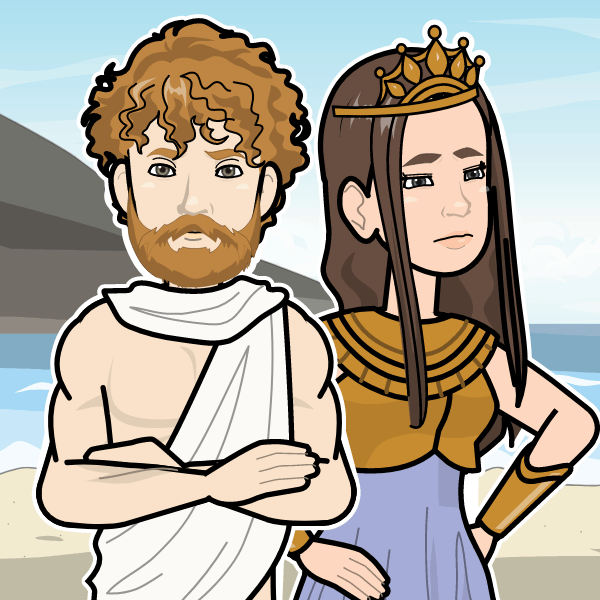
image: https://ideas.pixton.com/hubfs/the_big_12_in_greek_mythology-001.png
---

**Subject: Social Studies**

**Lesson Length: 30 - 35 mins**

**Topic: Greek Mythology**

**Grade Level: 6**

**Standards / Framework: **

- [C3: D2.His.4.6-8](https://www.socialstudies.org/sites/default/files/2017/Jun/c3-framework-for-social-studies-rev0617.pdf)
- [CCSS.ELA-LITERACY.W.6.7](https://learning.ccsso.org/wp-content/uploads/2022/11/ELA_Standards1.pdf)

**Brief Description:**  Students will begin to explore the twelve gods and goddesses in Greek mythology.

**Know Before You Start:** Students should have a basic understanding of Ancient Greek religion and the role it plays in the daily life of citizens in Ancient Greece. Students should know the terms: **polytheism**, **mythology**, **myth**, **Mt.** **Olympus**, **oracle**.

**Hook:**

- Ask students why we have the Olympics.
- Lead their responses to the celebration of the Greek gods and goddesses.

**Activity:**

- Have students create a one-to-two-panel comic introducing their selected Greek god or goddess. Their comic could include: 
    - Name of the god/goddess
    - The god/goddess' special power or protection
    - Their relationship(s) to other gods/goddesses
    - Their symbol or animal representation

**Closure:**

- Have students combine their comics to create a flow chart of the twelve gods/goddesses to show connections among them and create discussions around what they learned.

**Differentiation:**

- Allow students to use the speech-to-text feature.
- Allow students to use the voiceover feature to read their comics aloud.
- Allow students to work in pairs or groups as needed.
- Provide visuals and characteristics of each Greek god/goddess for students to reference.

**Resources:**

- [Comic](https://share.pixton.com/qle9cjj) to print or display

**Suggested Content:**

- [![](https://img.pixton.com/content-pack/1838241469325012992/thumbnail.png) Greek Mythology ](https://content.pixton.com/greek-mythology)
- [![](https://img.pixton.com/content-pack/1823352441442304000/thumbnail.png) Ancient Greece ](https://content.pixton.com/ancient-greece)
- [![](https://ideas.pixton.com/hubfs/thumbnail-odyssey.png) Odyssey ](https://content.pixton.com/odyssey)

Assign Activity

## Related Ideas

[![](https://ideas.pixton.com/hubfs/athens_and_sparta_are_they_the_same_or_different_-001.png)](https://ideas.pixton.com/athens-and-sparta-are-they-the-same-or-different)

### [Athens and Sparta: Are They the Same or Different?](https://ideas.pixton.com/athens-and-sparta-are-they-the-same-or-different)

Students will identify the similarities and differences between the Greek city-states, Sparta and Athens.

[![](https://ideas.pixton.com/hubfs/consequences-001-1.png)](https://ideas.pixton.com/consequences)

### [Consequences](https://ideas.pixton.com/consequences)

We are all faced with daily decisions, each of which has good and/or bad consequences. Our ability to tackle these choices in an informed and responsible manner is key to the development of our personal character. Illustrate the consequences of our decisions, big and small.

[![](https://ideas.pixton.com/hubfs/shape_classifications-001.png)](https://ideas.pixton.com/shape-classifications)

### [Shape Classifications](https://ideas.pixton.com/shape-classifications)

In this lesson, students will classify a given set of shapes and provide an explanation to justify their answer.