At a Glance:
| Grades: | 1, 2, 3 |
|---|---|
| Subject: | ELA (English Language Arts) |
| Topic: | Vocabulary Acquisition and Use |
| Lesson Length: | 1 - 2 class sessions |
Standards / Framework:
What will students learn in this activity?
Students will describe an animal's key attributes using adjectives.
What should students know before this activity?
Students should be familiar with the words describe and characteristics.
How can teachers introduce this lesson?
- Ask students:
- “How can we describe something or someone?”
- “What is an adjective?”
- “What are the characteristics of a _______?”
What will students do?
- Show a picture of an animal to the class and have students describe the animal.
- Prompt students to share responses that fit into three categories that will help the students describe the animal’s attributes. The anchor chart has three sections: “can”, “have”, and “are” to help students generate answers. For example, you can show a picture of a dog and students might write “run, eat dog food, bark, and be different sizes” under the “can” section. Students might say dogs have “fur, a tail, and paws.” Students may share that dogs are “mammals, pets, and sometimes adopted by people.” Complete this activity 2-3 times.
- Share with students some of the words they are using to describe animals using adjectives. Explain that adjectives describe a noun. Adjectives can explain an amount, a color, the size, how something looks, feels, or sounds, and how it behaves. Highlight the adjectives your class recorded.
- Have students turn and talk with a partner about additional adjectives to add to the chart.
- Have students read non-fiction texts independently about the animal of their choice.
- As students read, have them record facts by writing or drawing on a graphic organizer that has three sections labeled “can”, “have”, and “are” like the anchor chart activity.
- Provide students additional time to read and complete their graphic organizer.
- Have students select three attributes they would like to illustrate and write about in a comic.
How can teachers wrap up the lesson?
- Have students share their comics with the class or with a partner.
- Share with students that today they made comics that give readers facts about the animal they selected. When readers read non-fiction texts, they learn more about the world around them!
- Share with students how adjectives help us to understand the animal even better.
How can teachers differentiate this activity?
- Allow students to use the speech-to-text feature.
- Allow students to work in pairs or groups as needed.
- Allow students to use the voiceover feature to read their comics aloud.
- Provide students with a word bank of adjectives and verbs that can be used to describe their animals.
- Provide pre-selected texts for students to match their reading level.
- Provide students with a graphic organizer, such as the Main Idea Web as an alternative way to record their facts.
- Consider completing the research and note-taking in a small teacher-led group.
- When completing this lesson with Grade 2 students, consider including conversation about verbs to ensure students are fully addressing the standard CC.2.L.5.b.
Related Resources:
- Comic to print or display: Comic.
- Videos:
- Mammals for Kids by Learn Bright
- Physical Characteristics of Animals by Bethany Peterson
- Adjectives for Kids by Learn Bright
- Verbs for Kids by Learn Bright
- Books:
- National Geographic Kids Readers 6 Book Set (National Geographic Kids Readers, Levels : 1 & 2) by Anne Schreiber
- Junior Learning Science Decodables by Anna Kirschburg
- Main Idea Web
 Prehistoric
 Ocean
Ocean
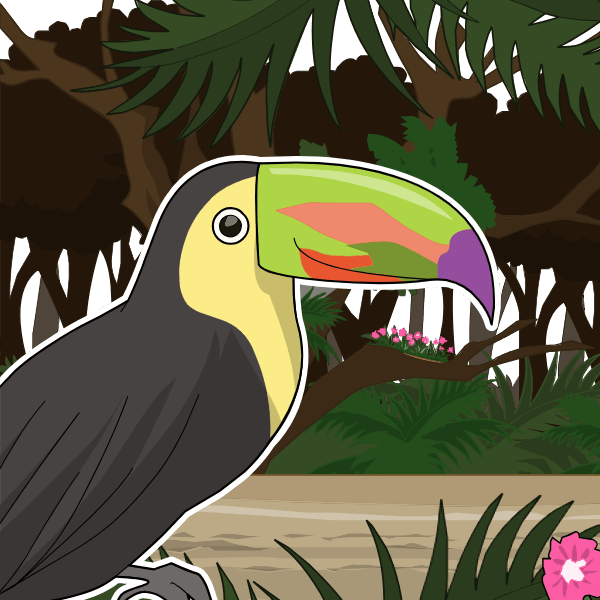 Rainforest
 Farm
Farm
 The Tale Of The Mandarin Ducks
Suggested Story Starters: